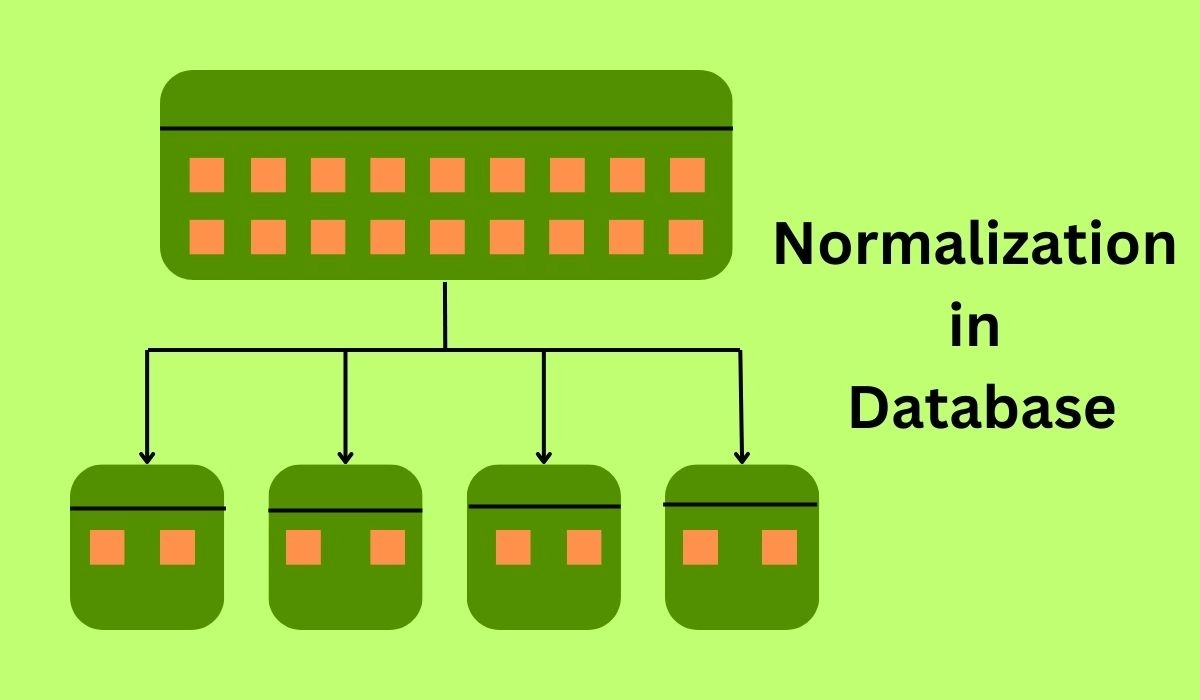
When designing databases, one of the biggest challenges developers face is organizing data efficiently while avoiding redundancy and inconsistencies. If a database is poorly structured, it can lead to duplicate data, update errors, and difficulty maintaining accurate records. To solve these problems, database designers use a process called database normalization.
Database normalization is a technique used to organize data in a database so that redundancy is minimized and data integrity is improved. The goal of normalization is to divide large tables into smaller, well-structured tables while maintaining relationships between them.
Relational database systems such as MySQL and PostgreSQL commonly use normalization principles to design efficient and scalable database structures.
Table of Contents
What is Database Normalization?
Database normalization is the process of structuring database tables in a way that reduces duplication and improves data consistency. Instead of storing repeated information in a single table, normalization separates data into multiple related tables.
This process ensures that each piece of data is stored only once, reducing the risk of inconsistencies when data is updated.
For example, imagine a table that stores student information along with course details. If a student is enrolled in multiple courses, their personal information might be repeated multiple times in the same table. Normalization solves this issue by separating student data and course data into different tables and linking them using keys.
Database Normalization is typically divided into several stages called normal forms. The most commonly used normal forms in database design are First Normal Form (1NF), Second Normal Form (2NF), and Third Normal Form (3NF).
First Normal Form (1NF)
The first normal form focuses on eliminating repeating groups and ensuring that each column contains atomic values. Atomic values mean that each field contains only a single piece of information.
A table is considered to be in First Normal Form if it meets the following conditions:
Each column contains only one value per row.
Each record can be uniquely identified.
There are no repeating groups of columns.
For example, consider a table that stores student data with multiple phone numbers in a single column separated by commas. This violates the rules of 1NF because a column contains multiple values.
To convert the table into First Normal Form, each phone number should be stored in a separate row or a separate related table.
By doing this, the database structure becomes cleaner and easier to manage.
Second Normal Form (2NF)
The second normal form focuses on removing partial dependencies. A table is in Second Normal Form if it is already in First Normal Form and all non-key attributes depend entirely on the primary key.
Partial dependency occurs when a column depends on only part of a composite primary key rather than the entire key.
For example, imagine a table that stores information about student enrollments:
- Student_ID
- Course_ID
- Student_Name
- Course_Name
In this table, Student_Name depends only on Student_ID, and Course_Name depends only on Course_ID. This means the table contains partial dependencies.
To achieve Second Normal Form, the table should be divided into separate tables.
Students Table
- Student_ID
- Student_Name
Courses Table
- Course_ID
- Course_Name
Enrollments Table
- Student_ID
- Course_ID
By separating the data into these tables, partial dependencies are removed, and the structure becomes more efficient.
Third Normal Form (3NF)
The third normal form focuses on removing transitive dependencies. A transitive dependency occurs when a non-key attribute depends on another non-key attribute rather than directly on the primary key.
A table is considered to be in Third Normal Form if it meets the following conditions:
The table is already in Second Normal Form.
All columns depend only on the primary key and not on other non-key columns.
For example, consider a table containing employee information:
- Employee_ID
- Employee_Name
- Department_ID
- Department_Name
In this case, Department_Name depends on Department_ID rather than Employee_ID. This creates a transitive dependency.
To achieve Third Normal Form, the table should be separated into two tables.
Employees Table
- Employee_ID
- Employee_Name
- Department_ID
Departments Table
- Department_ID
- Department_Name
By splitting the data into separate tables, transitive dependencies are eliminated and the database becomes more organized.
Advantages of Database Normalization
Normalization offers several important benefits for database systems.
- One major advantage is reduced data redundancy. When duplicate data is removed, the database requires less storage and becomes easier to maintain.
- Another benefit is improved data consistency. When data is stored in only one place, updates become simpler and errors are less likely to occur.
- Database Normalization also improves database flexibility. Changes to the database structure can be made more easily without affecting unrelated data.
- Additionally, normalized databases help enforce data integrity by ensuring that relationships between tables remain accurate.
When Normalization May Not Be Ideal
Although database normalization is important for database design, there are situations where strict normalization may reduce performance.
Highly normalized databases may require multiple table joins to retrieve data. In large-scale applications, these joins can sometimes slow down queries.
In such cases, developers may use a technique called denormalization. Denormalization intentionally introduces some redundancy to improve query performance.
Many modern systems balance normalization and performance optimization depending on the application requirements.
Real-World Example
Consider an online store application. Instead of storing customer details, product information, and order data in a single table, the system separates them into different tables.
- Customers Table stores customer details.
- Products Table stores product information.
- Orders Table stores order records.
- Order_Items Table links products to specific orders.
This normalized structure makes it easier to manage customer data, update product details, and track orders efficiently.
Conclusion
Database normalization is a fundamental concept in relational database design that helps organize data efficiently while reducing redundancy and inconsistencies. By dividing data into logical tables and establishing clear relationships, normalization improves data integrity and simplifies database management.
The first three normal forms, 1NF, 2NF, and 3NF provide a structured approach to designing well-organized databases. While normalization helps create clean and reliable database systems, developers must also consider performance and scalability when designing real-world applications.
Also Check Primary Key vs Foreign Key – Powerful Comparison – 2026









1 thought on “Database Normalization – Comprehensive Guide – 2026”