The demand for software is growing faster than ever. Businesses need applications for customer management, automation, analytics, and digital services. However, the shortage of skilled developers and the increasing complexity of software projects have created a major challenge. This is where Low-Code and No-Code development platforms are transforming the software industry.
Low-Code and No-Code tools allow users to build applications with minimal or no traditional programming. By using visual interfaces, drag-and-drop components, and automated workflows, these platforms enable faster development and lower technical barriers.
According to research from Gartner, low-code development is expected to account for the majority of application development activity in the coming years. In this article, we explore what low-code and no-code platforms are, how they work, their benefits, limitations, and how they are shaping the future of software development.
Table of Contents
What is Low-Code Development?
Low-Code development platforms allow developers to build applications using visual development tools while still providing the flexibility to write custom code when necessary.
These platforms include graphical interfaces where developers can design application workflows, user interfaces, and data integrations without writing large amounts of code.
Popular low-code platforms include:
Low-code platforms are commonly used by professional developers who want to accelerate application development while maintaining customization capabilities.
Key Features of Low-Code Platforms
Low-code platforms provide several powerful features:
- Visual development environment
- Pre-built templates and components
- Integration with APIs and databases
- Automated testing and deployment
- Ability to extend functionality with custom code
These features help development teams reduce development time while maintaining flexibility.
What is No-Code Development?
No-Code platforms go one step further by enabling non-technical users to build applications without writing any code at all.
These platforms rely entirely on visual tools and configuration-based development. Business users, product managers, and entrepreneurs can build applications using simple drag-and-drop interfaces.
Popular no-code platforms include:
No-code platforms are ideal for building prototypes, simple applications, and workflow automation tools.
Key Features of No-Code Platforms
No-code tools typically offer:
- Drag-and-drop UI builders
- Visual workflow automation
- Built-in database management
- Integration with third-party services
- Simple deployment options
These capabilities make it possible for non-developers to create functional applications quickly.
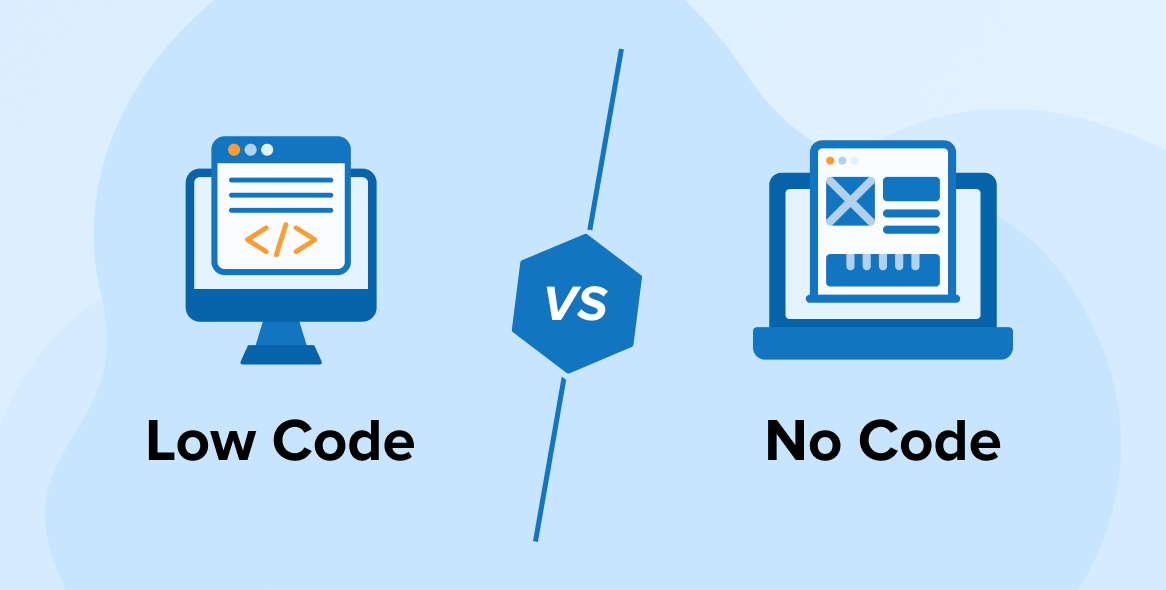
Low-Code vs No-Code: Key Differences
Although low-code and no-code platforms share similar goals, they serve different audiences and use cases.
Level of Technical Expertise
Low-code platforms are designed for developers or technical teams who want to speed up development while retaining control over customization.
No-code platforms are designed for non-technical users who want to build applications without programming knowledge.
Flexibility and Customization
Low-code platforms allow developers to add custom code when needed, making them suitable for more complex applications.
No-code platforms focus on simplicity and ease of use, which can limit customization options.
Complexity of Applications
Low-code platforms are often used for enterprise applications, internal tools, and scalable systems.
No-code platforms are typically used for smaller applications, prototypes, landing pages, and automation workflows.
Target Users
Low-code platforms target professional developers and IT teams.
No-code platforms target entrepreneurs, startups, and business professionals without programming backgrounds.
Benefits of Low-Code and No-Code Development
Low-code and no-code platforms provide several advantages for organizations and developers.
Faster Development
Visual development tools significantly reduce the time required to build applications. Teams can create prototypes and deploy solutions much faster than traditional coding approaches.
Lower Development Costs
Since less manual coding is required, organizations can reduce development costs and resource requirements.
Increased Productivity
Developers can focus on solving complex problems while routine tasks are handled by automated tools and templates.
Empowering Non-Developers
No-code platforms allow business teams to build tools and automate processes without relying entirely on engineering departments.
Rapid Prototyping
Startups and entrepreneurs can quickly build minimum viable products (MVPs) to test ideas and validate market demand.
Challenges and Limitations
Despite their benefits, low-code and no-code platforms also have limitations.
Scalability Issues
Applications built on no-code platforms may struggle to scale when user demand increases or system complexity grows.
Limited Customization
No-code platforms offer limited flexibility compared to traditional programming.
Vendor Lock-In
Organizations may become dependent on a specific platform, making migration difficult.
Security Concerns
Applications built quickly without proper security practices may introduce vulnerabilities. Organizations should follow security guidelines from resources like the OWASP Foundation to ensure safe development practices.
The Future of Low-Code and No-Code
Low-code and no-code platforms are expected to play an increasingly important role in the future of software development.
Several trends are shaping this future:
- Integration of AI-powered development assistants
- Increased automation of application workflows
- Expansion of enterprise-grade low-code platforms
- Greater collaboration between developers and business teams
Companies such as Microsoft and other major technology providers are heavily investing in low-code ecosystems, indicating strong industry momentum.
Rather than replacing traditional developers, these platforms will likely complement existing development practices.
Conclusion
Low-code and no-code development platforms are transforming how software is created. By reducing the need for extensive programming knowledge, these tools allow organizations to build applications faster, lower costs, and empower more people to participate in the development process.
While traditional programming will always remain essential for complex and large-scale systems, low-code and no-code platforms are expanding the possibilities of who can build software.
The future of software development will likely involve a hybrid approach where professional developers, AI tools, and low-code platforms work together to create innovative digital solutions more efficiently than ever before.
Also Check AI Agents in Software Development – Powerful Automation 2026